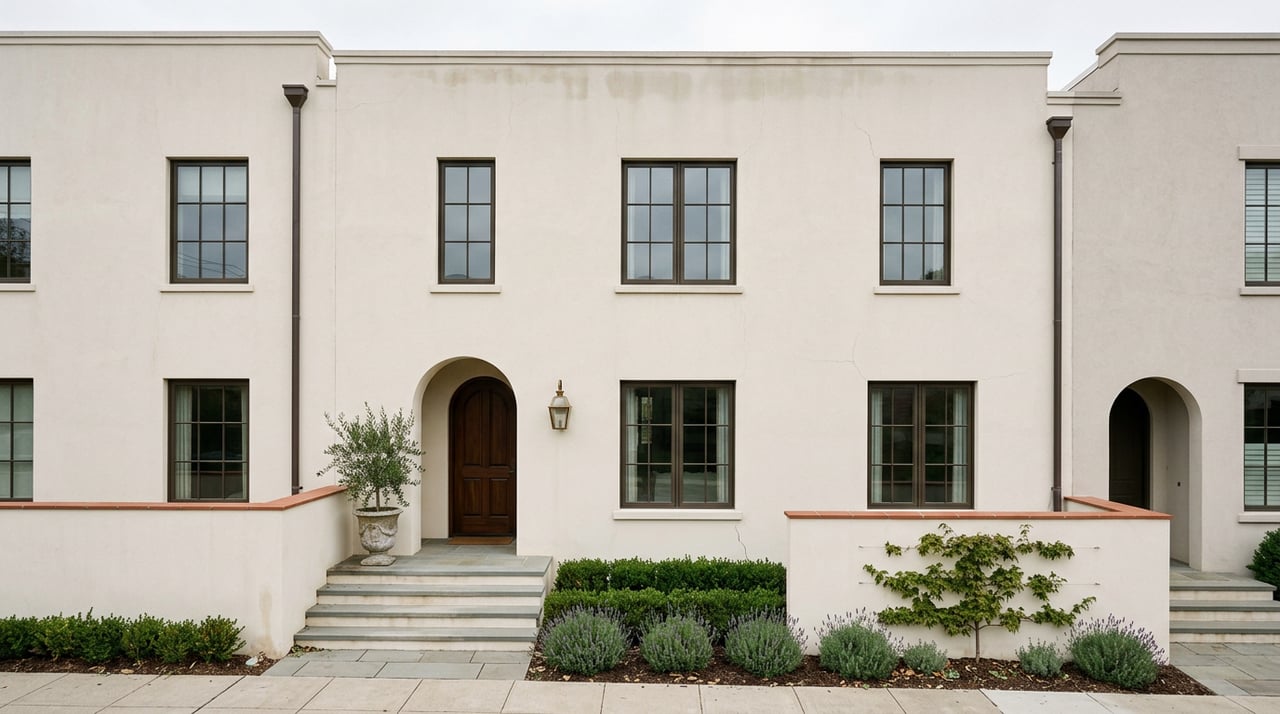
Walk the 2000 block of Union Street this week and you'll see butcher paper still taped inside the windows of 2055B, with a hand-lettered sign underneath announcing Franko & Friends. The permit paperwork is already filed with the state's alcohol control board, the owner has told local press she's aiming for an early September opening, and the pastries-and-coffee counter is set to become a wine bar once the sun goes down. If that sounds like two businesses crammed into one lease, that's because it is. It's also, on this particular stretch of Cow Hollow, not really news.
Look at what's already operating along this same run of Union Street and you'll notice the same split shift running quietly in the background. Roaming Goat, the Armenian and Georgian wine bar at 1830 Union, pours happy hour from three to five every afternoon and turns into a full brunch service on weekend mornings. Balboa Cafe, a few blocks over, has been serving lunch, brunch, and dinner out of the same room since 1913. Even Atelier Crenn's operation splits its hours across two connected spaces, the main dining room and its late-night sister bar, Bar Crenn, so that one kitchen effectively runs two shifts under one roof. Franko & Friends isn't introducing a new idea to Union Street. It's confirming one that's been paying the rent here for over a century.
The Math Behind Running Two Businesses Out of One Room
Union Street's retail rents have never been cheap, and a single-purpose storefront, a coffee counter that closes at 3pm or a wine bar that doesn't open until 5, only monetizes half the day it's paying for. The businesses that have lasted here, not the ones that opened with a splash and closed within a year, tend to be the ones built to work both shifts. A coffee and pastry counter that becomes a wine list after dark isn't a gimmick. It's a lease strategy, and the owner of Franko & Friends, Iryna Nevozhai, is applying it as an expansion of a concept she already runs across the bridge in Sausalito, where the original Franko & Co. operates primarily as a small daytime coffee shop. The San Francisco location is larger, which is precisely what gives her room to add the wine and sparkling service the Sausalito space can't fit.
There's a second detail buried in that same reporting that's easy to miss: Nevozhai chose this specific block partly because she found the neighborhood already has ties to Sausalito residents who cross the bridge regularly. That's not a small thing for a single storefront decision. It means the calculation behind opening here wasn't just about Union Street's foot traffic. It was about a customer base that already moves between these two towns on a routine basis, the same commuters and weekenders who know the Sausalito flagship and will recognize the name when they see it on this side of the bridge.
What the Morning-to-Night Rundown Actually Looks Like
If you strung together a single day using only what's already open on this stretch, it would look something like this:
- Morning coffee at Wrecking Ball, the tiny café known for its pineapple wallpaper and a seasonal pumpkin latte named for Karl the Fog, or a few doors down at Motoring Coffee, where a Porsche parked in the middle of the room has become as much a fixture as the espresso machine.
- Midday errands and browsing along the Victorian storefronts between Gough and Fillmore, the same blocks the Union Street Association closes to traffic every June for its street fair.
- Early evening happy hour at Roaming Goat, where the wine list leans into bottles from Armenia and Georgia rather than the usual Napa staples.
- A late dinner or a nightcap at Balboa Cafe, still pouring from the same bar it opened with in 1913.
Franko & Friends slots into the gap at the start of that list and the middle of it at once, a coffee stop that becomes a wine stop without anyone having to change addresses. That's the kind of detail that only becomes visible when you map the block as a single day rather than a list of individual businesses.
The One Place on the Block That Runs on the Opposite Clock
Not everything on this stretch is built to maximize hours. The McElroy Octagon House, moved to its current site in 1951 and now designated San Francisco Landmark 17, opens to the public exactly one day a month, the second Sunday, and stays shuttered the rest of the time. It's one of only three surviving octagon houses in the city, and the only one the public can actually walk into. Where Franko & Friends and Roaming Goat are optimizing every hour they can get out of a lease, the Octagon House is doing the opposite on purpose, treating scarcity itself as the point. Both approaches are native to this block. One turns over its floor plan twice a day to cover the rent. The other closes twenty-nine days out of thirty because being hard to get into is part of what makes it worth visiting when you can.
That contrast says something true about how Cow Hollow actually functions that a simple list of new openings wouldn't capture. This isn't a neighborhood chasing constant turnover for its own sake, the way some strips do. It's a corridor where businesses that need every operating hour they can get share a neighborhood with an institution that deliberately limits its own access to one Sunday a month, and both models have persisted for decades because each fits the kind of use it was built for.
Why This Is the Detail Worth Knowing
The easy read on a new coffee-and-wine concept opening on Union Street is that it's just another business trying something trendy. The more accurate read, once you look at what's already succeeding a few doors down, is that Franko & Friends is making the same bet that's kept Roaming Goat's happy hour full and Balboa Cafe's bar stools occupied since before the Golden Gate Bridge existed. On this particular block, the businesses that last aren't necessarily the ones with the best coffee or the deepest wine list. They're the ones that figured out how to be useful to the same customer twice in one day, once on the way to work and once on the way home from it.
That's a small mechanism, but it's the kind of thing you only notice if you've watched this block operate for a while rather than just scrolled past a list of what's new. It also explains something residents already sense without necessarily naming: Union Street doesn't behave like Chestnut Street's later, louder crowd, and it doesn't behave like a pure daytime shopping strip either. It runs on its own schedule, built one lease at a time by owners who did the math on what a single address could support across a full day.
If you live along this stretch, you already know which coffee counter you trust and which bar you end up at without planning to. The next few weeks will tell you whether Franko & Friends earns a place in that rotation, but the model it's built on has already been tested here for a long time.
For those who know this stretch of Cow Hollow well enough to have opinions about which bar stool is the good one, or who are weighing a move to a block that runs on this kind of rhythm, Ana T.L. Dierkhising welcomes the conversation. Let's Connect.